
The Life After Us
Concept Visualization #04
The Question
What continues after we are no longer there?
We leave traces everywhere.
A sentence written by hand.
A voice in a recording.
An object used for years.
A photograph.
A gesture someone remembers.
None of these things is a person.
Yet something of us continues to move through them.
What happens when these traces are encountered by someone else?
And can a portrait exist without ever showing the person?
The Idea
The Life After Us is a participatory archive made from traces of ordinary lives.
Instead of portraits of faces, visitors encounter fragments:
A handwritten note,
A recording,
A familiar object,
A piece of fabric,
A drawing,
A sentence,
A sound.
Each fragment is given a simple code rather than a person’s identity.
Visitors can listen, read, touch, observe or simply spend time with what they find.
If something moves through them, they are invited to respond.
A word may become a drawing.
A recording may awaken a memory.
Someone else’s sentence may become the beginning of another person’s story.
The response then becomes another trace in the archive.
A portrait is no longer something we look at.
It becomes something that continues.
Why
We usually think of a portrait as a way of preserving a person.
A face.
A name.
A biography.
But perhaps a person also exists through the countless small things that pass through other lives.
The way someone speaks may change how another person thinks.
An object may outlive its owner.
A sentence written years ago may suddenly mean something to a stranger.
We rarely know how far these traces travel.
The Life After Us asks whether identity can be understood not only through who we are,
but through what continues because we were here.
How It Works
1. Encounter a Trace
Visitors enter a space containing fragments from different lives.
There are no conventional portraits and very little biographical information.
Each trace carries only a code:
0047
0132
0206
0236
0271
You do not begin by knowing who someone was.
You begin with what they left.
2. Take What Moves Through You
Visitors are free to explore the archive.
They might put on headphones.
Read a handwritten note.
Hold an object.
Look through a notebook.
Listen to someone’s voice.
There is no requirement to understand everything.
The invitation is simply:
Take what moved through you.
3. Let It Become Something Else
An encounter may produce a response.
A thought.
A memory.
A word.
A drawing.
A question.
A visitor who encounters trace 0271, for example, might leave behind one word:
LOVE
The response does not need to explain the original trace.
It records what the encounter became inside someone else.
4. Leave What It Became
The visitor’s response returns to the archive.
It receives its own place among the existing traces.
What began with one person has now passed through another.
Leave what it became.
The archive grows not by collecting more information about people, but by recording how traces continue to change.
5. Enter the Living Code
Over time, the archive becomes a constellation of connections.
0047 → 0271 → LOVE → another response → another person
Visitors may see these relationships represented as an evolving visual network.
No single trace tells the whole story.
Together, they reveal how one life can quietly move through many others.
A Portrait Without Portraits
Eventually, the codes and responses can be gathered into a shared book or digital archive.
A bowl.
A melody.
A handwritten sentence.
A flower.
LOVE.
None is a portrait by itself.
Together, they form something closer to one:
a portrait made from what passed between people.
Possible Locations
Museum or gallery
Libraries and archives
University
Community space
Festival
Community Square
Public cultural spaces
Memory and oral-history projects
Artist residency
Temporary exhibitions
Design Principles
✓ Participatory
✓ Evolving
✓ Open-ended
✓ Multi-sensory
✓ Anonymous before biographical
✓ Human-scale
✓ Trace-based
✓ No single interpretation
Experience Intention
To explore how one life can continue inside another.
The project is not designed to reconstruct a complete person.
Instead, it asks what happens when fragments of one life enter another person’s experience.
Perhaps what remains of us is not a perfect record of who we were.
It is something less complete and more alive.
Something remembered differently.
Something reinterpreted.
Something carried forward.
What We’re Exploring
Can a portrait exist without showing a person?
What happens when a trace is separated from the identity that created it?
When does remembering become creating?
Can one person’s experience continue through someone else’s?
Possible Extensions
The Living Archive
The physical installation could develop into a growing digital archive where traces and responses remain connected over time.
Across Places
A trace left in one city could be encountered and transformed by someone in another, allowing the archive to travel without moving the original person or object.
Across Generations
Family or community archives could allow objects, handwriting, recordings and memories from different generations to enter the same evolving system.
AI & Reconstruction
A later experiment could explore what happens when AI attempts to interpret or reconstruct a person from incomplete traces and where the boundary lies between evidence, interpretation and invention.
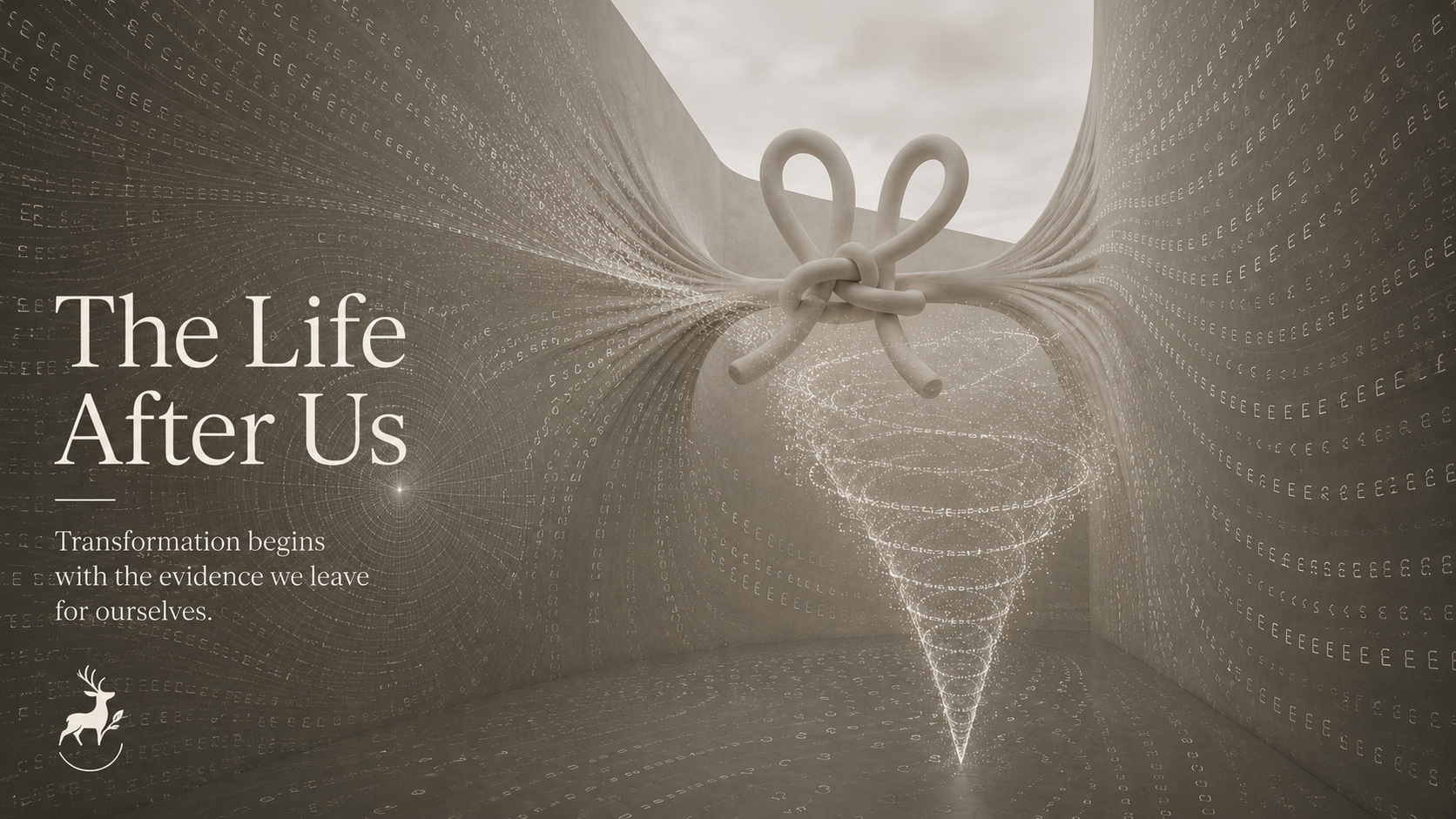
A conceptual digital artwork for The Life After Us